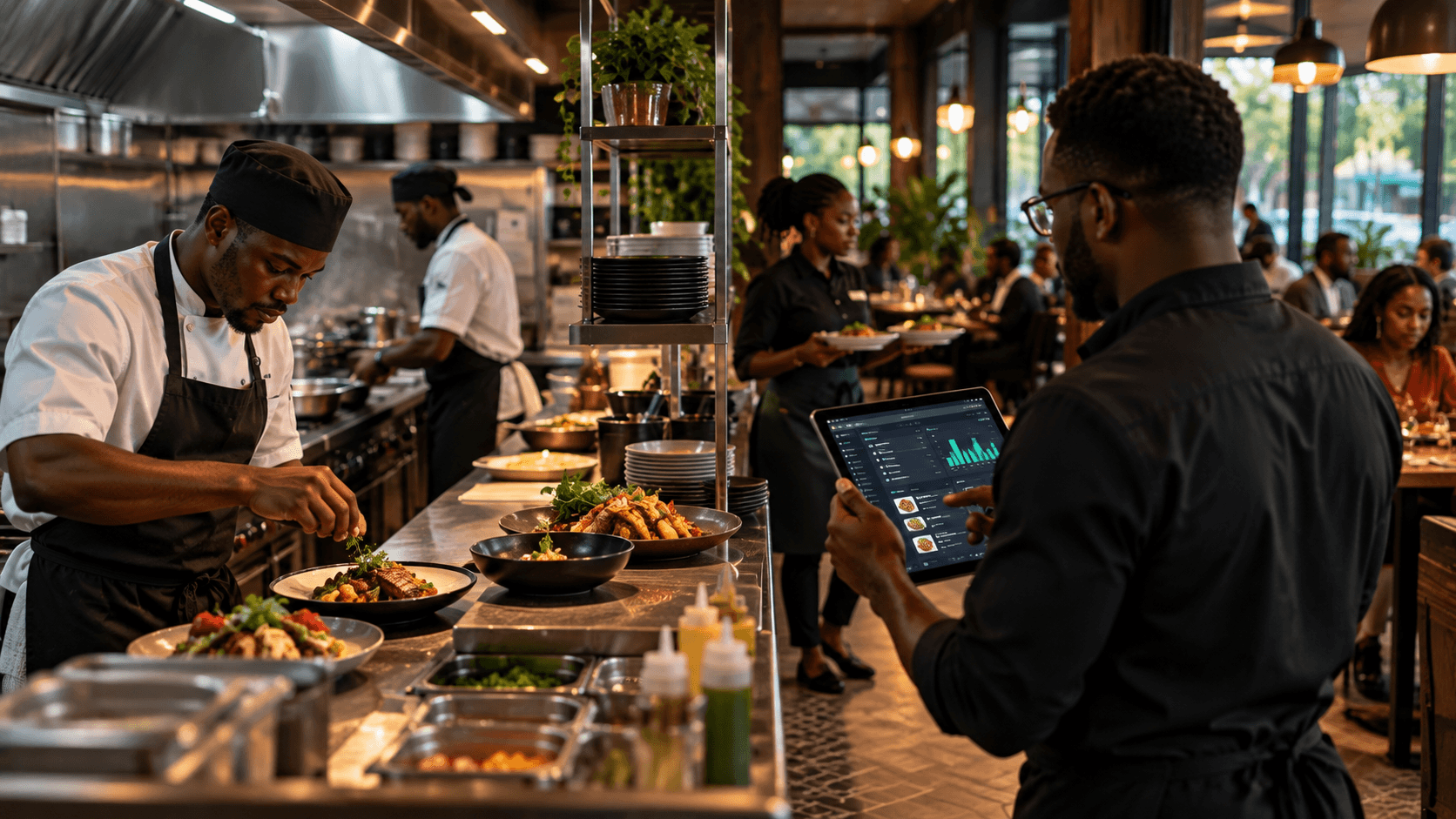
From Customer Demand to Kitchen Decisions: Connecting Both Sides of Hospitality
Every customer order tells a story, and every kitchen decision shapes the customer experience. Discover how PrepStak is connecting food discovery, customer demand, and kitchen intelligence to help hospitality businesses make better decisions.
In this article
- Two Sides of the Same Business
- What Happens When Demand and Operations Don't Connect?
- Understanding Demand Beyond Yesterday's Sales
- PrepOrder: Understanding What Customers Are Looking For
- PrepIQ: Turning Operational Information Into Better Decisions
- What Becomes Possible When Both Sides Connect?
- Intelligence Should Connect Decisions, Not Remove Human Control
- Connection Must Be Built on Trust
- Beyond Individual Transactions
- Building the Connected Hospitality Ecosystem
Audio edition
Listen at your own pace.
It's Friday afternoon.
A Restaurant is preparing for its busiest evening of the week.
The kitchen team is reviewing ingredients, planning production, and making decisions about how much food to prepare.
Meanwhile, customers across the city are deciding what to eat.
Some are searching for affordable meals. Others are looking for something specific. A few are planning dinner with friends, while others are exploring Restaurants they've never tried before.
These two activities are deeply connected.
What customers want influences what kitchens need to prepare. And what kitchens can prepare influences what customers can order.
Yet in many hospitality businesses, these decisions happen with limited visibility into one another.
The kitchen works with historical sales, experience, and available stock.
The customer-facing side works with menus, promotions, availability, and incoming orders.
Both are making decisions about the same business, often using different information.
At PrepStak, we believe connecting these two perspectives represents one of the most meaningful opportunities in hospitality technology.
Two Sides of the Same Business
Every Restaurant operates across two fundamental realities.
The first is customer demand.
People discover food, compare options, respond to promotions, develop preferences, and eventually place orders.
The second is operational capacity.
Restaurants purchase ingredients, plan preparation, manage inventory, coordinate kitchen teams, and fulfill those orders.
These activities cannot be separated in practice.
A popular dish creates demand that the kitchen must be prepared to satisfy.
A shortage of ingredients affects what the Restaurant can confidently offer.
An unexpected increase in orders may require adjustments to production.
A quiet afternoon may create an opportunity to promote dishes the kitchen is already prepared to serve.
The relationship is continuous.
And yet, the technology supporting each side frequently captures only part of the picture.
Understanding hospitality requires understanding both demand and the operational decisions needed to meet it.
What Happens When Demand and Operations Don't Connect?
Consider a Restaurant known for its grilled chicken meals.
Over several days, the Restaurant notices increasing sales of one particular dish.
Its point-of-sale system records those transactions.
But unless that information contributes to preparation planning, the kitchen may continue producing quantities based largely on previous routines.
If demand continues growing, the Restaurant could face shortages during service.
Now imagine another situation.
A Restaurant prepares a dish that doesn't sell as quickly as expected.
The kitchen recognizes the slowdown, but the business has limited ways to connect that information with customers who might be interested in the dish.
The result may be unnecessary waste or a missed commercial opportunity.
These examples reveal a broader challenge.
Customer demand and kitchen operations influence each other, but the information connecting them is not always available when decisions are made.
More importantly, the solution isn't simply to collect more data.
It's to make existing information useful across the decisions that matter.
Understanding Demand Beyond Yesterday's Sales
Historical sales are an important part of Restaurant planning.
They reveal what customers purchased, when they purchased it, and how ordering patterns changed over time.
But sales data alone doesn't always tell the complete story.
A dish may record fewer sales because customers stopped wanting it.
Or because it was unavailable.
A promotion may increase demand temporarily.
A local event may change the number of customers visiting an area.
Seasonality, weather, holidays, and other circumstances can influence customer behavior.
Understanding these factors requires context.
It also requires distinguishing between different kinds of information.
A completed order represents actual purchasing behavior.
A search or menu view may suggest interest, but it does not guarantee a future sale.
A cancelled order or stockout may reveal demand that wasn't successfully fulfilled.
These distinctions matter.
A kitchen should not increase production simply because a dish received more views online.
But reliable customer-demand signals, considered alongside sales history and operational information, could help managers make better-informed decisions.
The opportunity is not to predict customer behavior with certainty. It is to reduce uncertainty where reliable information makes that possible.
PrepOrder: Understanding What Customers Are Looking For
PrepOrder is PrepStak's food discovery and ordering platform.
Its purpose is to make food easier to discover while creating opportunities for Restaurants to connect with interested customers.
Traditionally, food ordering often begins with selecting a Restaurant and browsing its menu.
But customers don't always think that way.
Someone might be looking for a spicy chicken meal under a particular budget.
Another person may want something light for lunch.
A family might need several meals that accommodate different preferences.
PrepOrder approaches discovery around these everyday intentions.
Through intelligent search, food recommendations, and conversational assistance, we're building experiences that help customers find relevant dishes offered by Restaurants.
For businesses, this creates another perspective on customer demand.
Beyond the final order, there may be useful signals about the kinds of food people are exploring, the offers attracting attention, and the dishes customers choose.
Those signals need to be interpreted carefully.
Interest is not the same as purchasing intent, and purchasing intent is not the same as a confirmed sale.
But when appropriately aggregated, authorized, and evaluated, customer-facing information can contribute to a more complete understanding of demand.
PrepOrder focuses on helping customers discover food while creating meaningful opportunities for Restaurants to be discovered.
PrepIQ: Turning Operational Information Into Better Decisions
Understanding customer interest is only part of the challenge.
A Restaurant must still decide how to respond.
How much food should the kitchen prepare?
Which ingredients might require attention?
Are production quantities drifting away from actual sales?
Could a change in demand affect tomorrow's preparation plan?
These are the kinds of operational questions behind PrepIQ.
PrepIQ is PrepStak's kitchen intelligence and margin protection platform.
It is designed to work with relevant operational information, including sales and production data, to help Restaurants improve planning and understand performance.
Its forecasting capabilities aim to support preparation decisions using historical patterns and relevant contextual signals.
Its operational intelligence is designed to help managers recognize variations, investigate potential waste, and identify situations requiring attention.
The objective is not to replace chefs, managers, or the systems they already use.
It is to provide better information for decisions they already make.
A forecast remains an estimate.
A recommendation remains something to evaluate.
And operational data must be reliable enough to support the conclusions drawn from it.
PrepIQ focuses on helping Restaurants understand what is happening inside their operations and make more informed decisions about what happens next.
What Becomes Possible When Both Sides Connect?
This is where the broader PrepStak ecosystem comes into focus.
PrepOrder and PrepIQ address different problems.
One connects Restaurants with customer demand.
The other helps Restaurants understand operational demand, preparation, and performance.
Each is intended to provide value independently.
But consider what becomes possible when a Restaurant chooses to connect relevant information between them.
Scenario 1: Demand Informs Preparation
A Restaurant receives orders through multiple channels.
Its kitchen intelligence system analyzes historical sales, known operational patterns, and relevant contextual information.
Customer demand captured through PrepOrder could contribute additional authorized signals.
Rather than relying on one source, the Restaurant could develop a more complete understanding of demand.
The kitchen manager reviews the resulting forecast and decides how to adjust preparation.
The system supports the decision.
The manager remains in control.
Scenario 2: Kitchen Readiness Informs Customer Offers
Imagine a Restaurant has ingredients and preparation capacity available for a particular dish.
The kitchen identifies an opportunity to increase sales without creating unnecessary operational pressure.
PrepIQ could help surface that opportunity.
Through an authorized connection, the Restaurant could review a proposed offer or visibility adjustment for PrepOrder.
The Restaurant decides whether to approve it.
Once approved, customers could discover the relevant offer through PrepOrder, subject to current pricing, availability, and eligibility rules.
This creates a possible connection between operational readiness and customer demand.
It doesn't require an AI system to make commercial decisions without oversight.
Scenario 3: Availability Becomes More Reliable
A dish may appear on a menu even when the Restaurant is temporarily unable to prepare it.
That creates a frustrating experience for customers and unnecessary work for Restaurant staff.
A connected operational workflow could help reduce this gap.
Relevant kitchen availability information could support a proposal to update what customers can order.
The Restaurant could review the proposed change, or explicitly authorize an appropriate operational synchronization.
PrepOrder would then apply its own ordering, eligibility, and availability rules.
The objective would be straightforward:
Help customers discover food that Restaurants can actually fulfill.
These scenarios illustrate the connected workflows we're designing toward. They are not claims that every integration or automated action is already available today.
They demonstrate why the relationship between customer demand and kitchen operations deserves more attention.
Intelligence Should Connect Decisions, Not Remove Human Control
When people imagine connected AI systems, they sometimes picture software making decisions automatically across an entire business.
A model predicts demand.
Another changes production quantities.
Another launches a promotion.
Another adjusts menu availability.
All without human involvement.
While automation can be useful, we don't believe every decision should be treated the same way.
A system identifying a possible opportunity is different from a system executing a business action.
Changing what a Restaurant promotes, sells, or prepares can have financial and operational consequences.
These actions require appropriate permissions, reliable information, and clear accountability.
At PrepStak, our approach is to distinguish between intelligence, recommendations, and approved actions.
A system may identify a pattern.
It may explain why that pattern matters.
It may recommend a response.
But the Restaurant should retain appropriate control over consequential decisions.
Connected intelligence should make people more capable, not make their judgment irrelevant.
Connection Must Be Built on Trust
There is another important consideration.
Connecting products does not mean sharing every piece of information between them.
A Restaurant's operational information is commercially sensitive.
Customer information deserves appropriate privacy protections.
An ecosystem must respect both.
That means connections should be purposeful and authorized.
Information should only be shared where there is a legitimate reason and appropriate permission.
Businesses should understand what they are connecting, what information is involved, and what actions the connection permits.
And the products must remain useful independently.
A Restaurant using PrepIQ should not be required to adopt PrepOrder.
A Restaurant using PrepOrder should not need PrepIQ to receive orders or reach customers.
The value of the ecosystem should come from useful connections, not forced dependencies.
A truly connected platform must also be one that businesses can trust.
Beyond Individual Transactions
It's easy to think of Restaurant technology in terms of individual actions.
An order is placed.
A payment is processed.
An ingredient is consumed.
A report is generated.
But hospitality operates as a continuous cycle.
Customer behavior influences demand.
Demand influences preparation.
Preparation influences availability.
Availability influences the customer experience.
And the outcomes of today's decisions provide information that can improve tomorrow's planning.
When information remains isolated, businesses may struggle to recognize these relationships.
When the right information connects, each part of the operation can contribute to a better understanding of the whole.
This is the opportunity we see.
Not simply creating more reports.
Not simply introducing more AI features.
But helping hospitality businesses turn everyday activity into meaningful operational intelligence.
Building the Connected Hospitality Ecosystem
PrepStak exists because we believe hospitality technology can be more connected, more intelligent, and more useful.
Our vision is to develop specialized products that solve practical challenges while creating opportunities for those products to work together.
PrepOrder focuses on customer discovery and demand.
PrepIQ focuses on kitchen intelligence and operational decisions.
Together, they represent two important parts of a much larger hospitality journey.
Our responsibility is to build those connections carefully, with dependable information, thoughtful product design, and respect for the businesses using our technology.
Because the future of hospitality isn't only about how efficiently a Restaurant processes an order.
It's also about how intelligently that Restaurant understands demand, prepares for it, fulfills it, and learns from the outcome.
From customer demand to kitchen decisions, every part of the business is connected.
We believe its technology should be too.
PrepStak.
The connected technology ecosystem for hospitality businesses.
Want to continue the conversation?
Talk to prepStak